
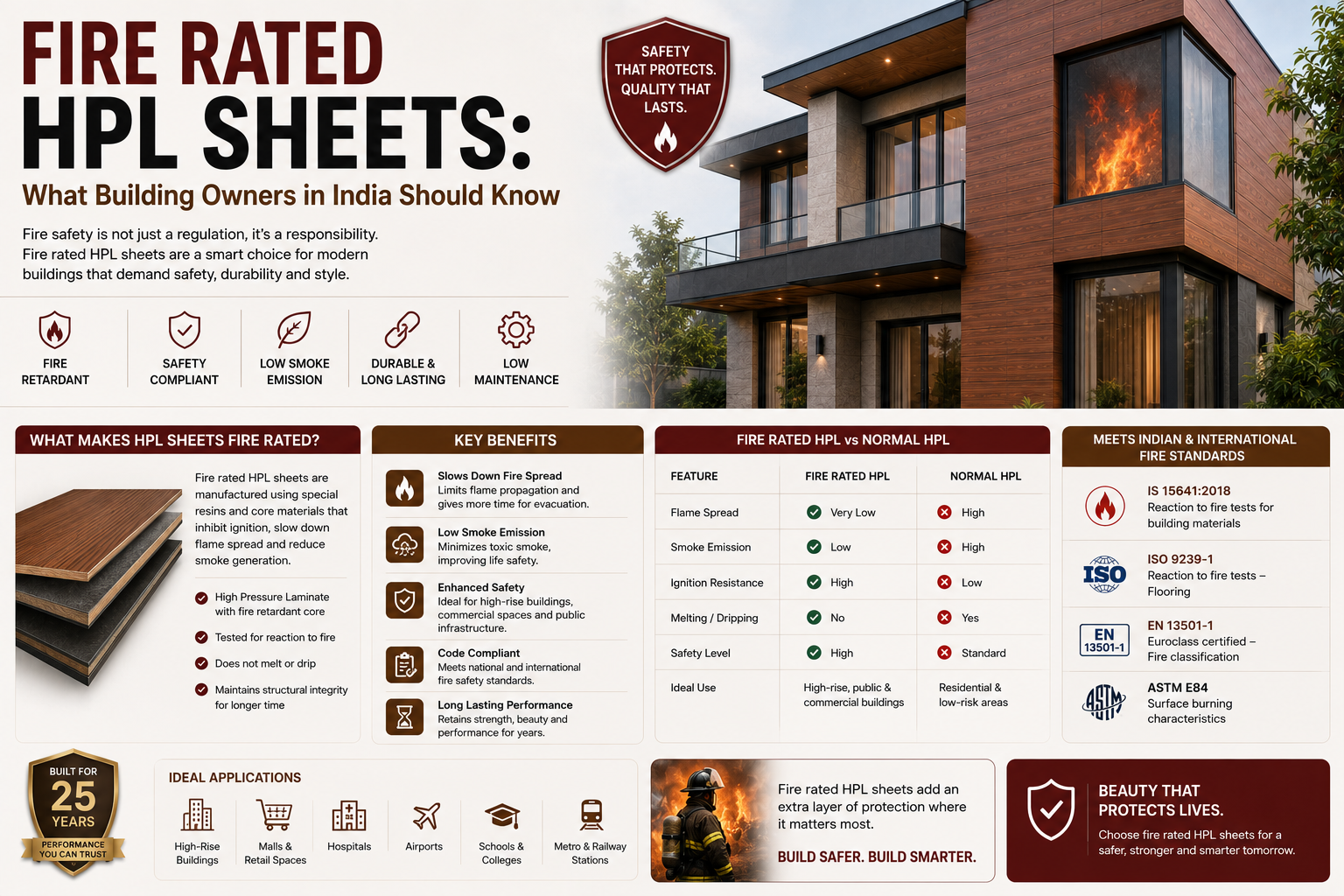
Quick answer: Fire retardant (FR) HPL is manufactured with additives in the resin and core that slow ignition and limit flame spread, and it is classified by laboratory testing rather than by claim. Standard HPL is combustible. For tall buildings, hospitals, schools, hotels and assembly occupancies, specify a tested FR grade and obtain the test report for the exact product code and thickness being supplied.
Table of Contents
- Why Facade Fire Performance Became a Priority
- How Fire Retardant HPL Differs from Standard HPL
- What the National Building Code Expects
- Questions to Ask Your Supplier
- The Assembly Matters as Much as the Panel
- Frequently Asked Questions
Why Facade Fire Performance Became a Priority
Several high-profile building fires internationally have shown that the outer skin of a building can turn a contained room fire into a full-height event. The mechanism is consistent: a combustible layer in the cladding assembly ignites, the cavity behind the panels acts as a chimney, and flame climbs faster than any evacuation plan assumes.
The lesson is not that cladding is dangerous. It is that the whole assembly – panel, insulation, cavity, cavity barriers and fixings – has to be considered as one system, and every layer needs documented performance.
How Fire Retardant HPL Differs from Standard HPL
Standard HPL is made of kraft paper and thermosetting resin. Both are organic, so the panel is combustible. FR grade changes the recipe.
- Modified resin system that raises the ignition threshold and reduces heat release.
- Fire retardant additives distributed through the kraft core rather than applied as a surface coating.
- Char formation – the panel forms a carbonised surface layer that insulates the material behind it and slows flame progress.
- No molten burning core, which is the specific behaviour that makes polyethylene-cored composite panels hazardous.
- Classified performance that can be verified against a recognised reaction-to-fire test method.
Importantly, FR HPL is fire retardant, not fireproof. No decorative laminate is non-combustible. The purpose of FR grade is to buy time and to limit spread, which is exactly what life safety design depends on.
What the National Building Code Expects
India’s National Building Code sets out fire and life safety requirements by building height and occupancy. Rather than naming brands, it establishes the performance expectations that a facade assembly must meet, and local fire departments approve drawings against those expectations.
| Building type | Typical expectation | Practical implication |
|---|---|---|
| Low-rise residential | Standard requirements | Exterior grade HPL is commonly accepted |
| High-rise residential and commercial | Stringent facade fire performance | Specify tested FR grade and cavity barriers |
| Hospitals and healthcare | Very stringent, evacuation is slow | FR grade plus documented assembly testing |
| Schools and colleges | High occupancy, young occupants | FR grade strongly recommended throughout |
| Hotels and assembly | Sleeping or dense occupancy risk | FR grade plus fire consultant sign-off |
Because interpretation varies by state and by fire officer, the safest route is to involve a fire consultant early and to submit the panel test report with the drawings rather than after installation has begun.
Questions to Ask Your Supplier
- Is this FR grade or standard grade? Get the answer on the quotation, in writing.
- Which test method was used, and what classification was achieved?
- Does the report cover this exact thickness, or only a thicker sample?
- How recent is the report, and is it traceable to current production batches?
- What is the recommended cavity design and are cavity barriers included in the scope?
- Does the fixing system – brackets, rails, fasteners – have its own fire documentation?
The Assembly Matters as Much as the Panel
A tested FR panel installed over combustible insulation with an unbroken 40mm cavity running twelve floors is not a fire-safe facade. Three details make the difference:
- Cavity barriers at floor lines and around openings to interrupt vertical flame paths.
- Non-combustible insulation where insulation is part of the build-up.
- Metal sub-frame and fixings that hold the panel in place long enough for the panel’s fire performance to be meaningful.
Specify all three together and the facade performs as a system. Specify only the panel and you have bought a certificate rather than safety.
Key Takeaways
- FR HPL uses modified resin and additives to slow ignition and limit flame spread; it is not fireproof.
- Fire performance must come from a tested classification, never from a brochure adjective.
- The National Building Code drives expectations by building height and occupancy.
- Test reports should match the exact product code and thickness being supplied.
- Cavity barriers, non-combustible insulation and metal framing are part of facade fire safety.
Frequently Asked Questions
Is HPL fire resistant?
Standard HPL is combustible because it is made from kraft paper and resin. Fire retardant grades are manufactured with modified resin and additives that slow ignition and limit flame spread, and their performance is verified by laboratory testing rather than by claim.
Do I need fire rated HPL for a house?
For a typical low-rise home, exterior-grade HPL is commonly accepted. FR grade becomes important for high-rise buildings, hospitals, schools, hotels and any assembly occupancy, and is a sensible upgrade anywhere near escape routes.
Is HPL safer than ACP in a fire?
Fire retardant HPL chars in place rather than releasing a molten burning core, which is the specific failure mode associated with polyethylene-core composite panels. That said, both materials must be assessed on the actual tested classification of the product supplied.
What documents prove fire performance?
A reaction-to-fire test report from a recognised laboratory, naming the test method, the product code, the thickness tested and the classification achieved. A supplier-issued certificate with no laboratory or method named proves nothing.
Does the sub-frame affect fire safety?
Significantly. A metal sub-frame, non-combustible insulation and correctly placed cavity barriers determine whether flame can travel behind the panels. Facade fire safety is an assembly property, not a panel property.
Related Reading on HPL Maker
Talk to HPL Maker
HPL Maker is an Indian manufacturer of exterior-grade high pressure laminate with an industry-first live camera warranty of up to 25 years. Share your drawings or elevation photos and our team will suggest the right shade, thickness and fixing system for your project.
- Call / WhatsApp: +91 89824 90236
- Email: marketing@hplmaker.com
- Factory & Head Office: 124-126, Vrindavan Palace, Nipania Main Road, Vijay Nagar, Indore – 452010, Madhya Pradesh, India